Meetings, Cataract, Patient Journey, Refractive, Refractive Surgery
Refractive Patients Have High Expectations
Large study characterises contemporary drivers behind cataract and refractive surgery choices.


Cheryl Guttman Krader
Published: Monday, October 19, 2026
“ Our data showed that patient- driven lifestyle preferences, particularly the desire for appliance independence, were key motivators for patients considering refractive surgery. “
Findings of a large multicentre study assessing patient motivations and suitability for cataract and refractive surgery underscore the importance of conducting patient-centred consultations. These consultations should address clinical and lifestyle expectations within digital care pathways to ensure informed decision making and optimised patient satisfaction postoperatively, concluded researchers from UK Optegra Eye Health Centres.
The research analysed information from 16,307 patients who participated in a virtual consultation with an optometrist.
“Refractive surgery can improve visual function and quality of life by reducing dependence on spectacles or contact lenses. However, the decision to undergo an elective surgical procedure is rarely based on visual acuity and refractive error alone,” said Clare O’Donnell PhD. “Patients may be motivated by practical, occupational, lifestyle, psychological, and social considerations, and the relative importance of these factors is likely to vary according to age, visual requirements, experience of alternative methods of refractive correction as well as the procedures being considered.
“As providers we naturally spend a lot of time reviewing our patient suitability criteria, optimising our pathways, refining our procedures, and assessing the safety and efficacy of the surgery. We arguably spend less time thinking about what brings patients to see us in the first place. Since there have been changes in both visual needs relating to an increased reliance on digital technology and in our procedure offerings since much of the previous research on this topic was published, we conducted this study to improve our understanding of what currently motivates people to explore surgical options for refractive correction.” 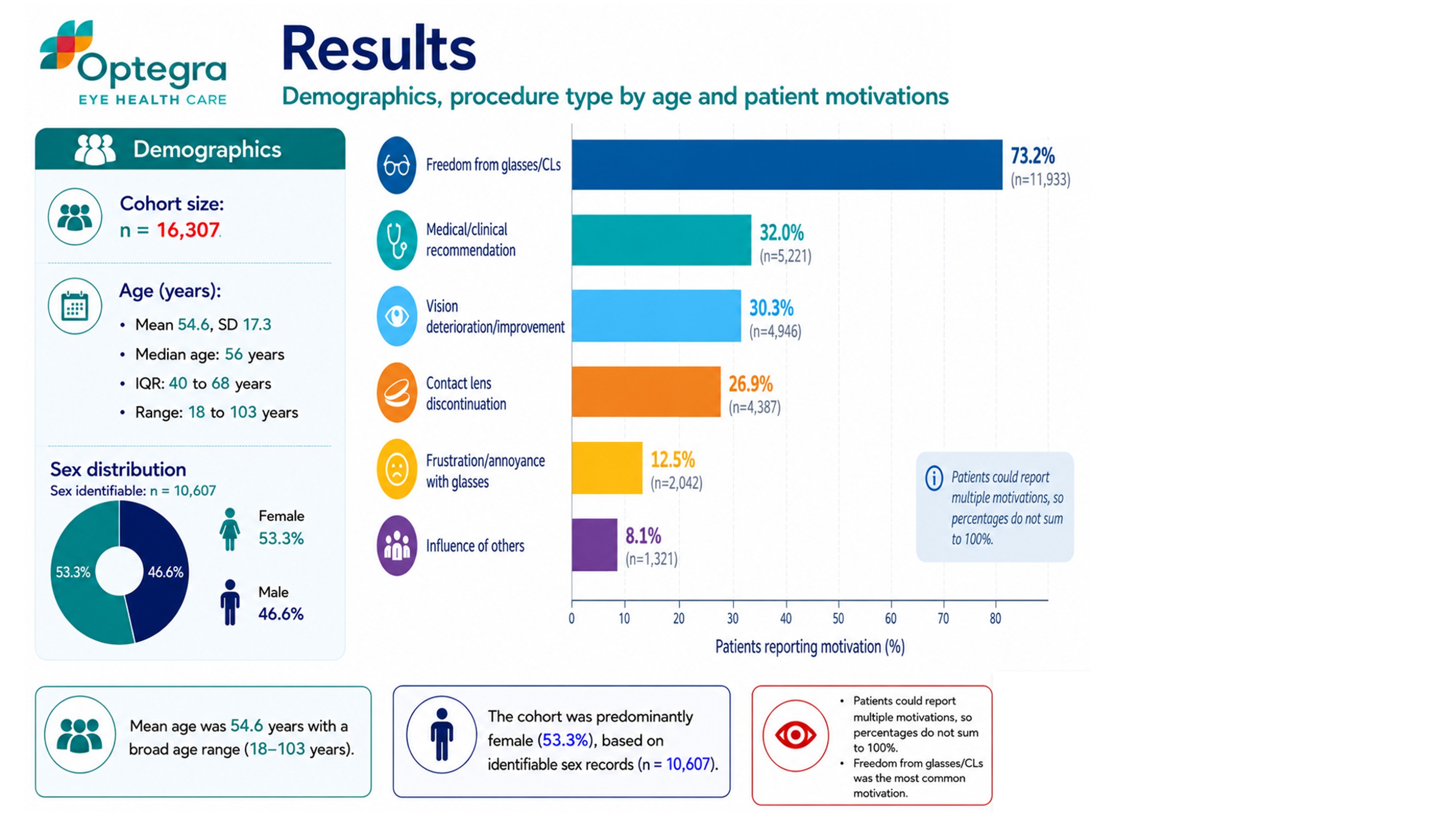
The study involved a retrospective audit of patients who attended a virtual consultation because they were considering refractive laser, phakic IOL, or cataract surgery. Free text motivation statement data were extracted from the consultation notes and analysed using Python. Motivation statements were summarised and stratified by age, sex, procedure type, and contact lens use. The 16,307 patients ranged in age from 18 to 103 years (mean was approximately 55 years), and 53% were female.
The analyses showed that desire for freedom from glasses or contact lenses was the most frequently reported motivation (73.2%), followed by clinical recommendation (32.0%), vision deterioration/need for improvement (30.3%), and contact lens discontinuation (26.9%). However, motivations for exploring surgical options for refractive management varied by age, procedure, and contact lens experience. Contact lens discontinuation predominated in patients younger than 40 years old, while spectacle independence and clinical need became increasingly important in older age groups. Clinical recommendation was frequently cited as a motivation in IOL surgery patients (65.7%). Among patients wishing to cease contact lens wear, the main reasons given were a desire for lens independence, problems with dry eye, poor visual performance, and difficulty handling lenses.
“Our data showed that patient-driven lifestyle preferences, particularly the desire for appliance independence, were key motivators for patients considering refractive surgery,” Professor O’Donnell concluded. “Spectacles, contact lenses, and surgery are options that exist throughout the patient’s refractive lifecycle. Better understanding clinical need and lifestyle preferences throughout our patients’ journeys may allow us to better support decision making through informed and individualised counselling, expectation management, and treatment selection, whatever option is ultimately chosen.”
Clare O’Donnell BSc (Hons), PhD, MBA, MCOptom is Head of Eye Sciences at Optegra Eye Health Care and Reader at Aston University, Birmingham, UK.