Meetings, Cornea
Evidence Supports Individualised Timing for Trans-PRK and CXL
Study documents similar outcomes for simultaneous versus sequential accelerated corneal cross- linking and transepithelial PRK.


Cheryl Guttman Krader
Published: Monday, October 19, 2026
Stromal haze profiles and visual, tomographic, and aberrometric outcomes at 12 months after customised transepithelial photorefractive keratectomy (trans-PRK) and accelerated corneal cross-linking (A-CXL) are similar whether the two procedures are performed in a single session or using a staged strategy, reported Shady Awwad MD in a free paper presentation at ESCRS 2026.
“We performed this study to address a very controversial question, one that, despite nearly 17 years of discussion, has never really been conclusively answered: When combining customised PRK with CXL to treat keratoconus, is it better to perform the two procedures simultaneously, or sequentially, with CXL first and PRK later? Previous studies provided conflicting results, particularly regarding corneal haze, safety, efficacy, refractive outcomes, and long-term stability,” said Dr Awwad.
“To identify any true impact of the surgical sequence, we compared propensity score-matched groups and used a validated, OCT-based, machine-learning method to objectively quantify haze rather than relying on a subjective grading system, such as the Fantes scale (Figure 1). Having found that the simultaneous and sequential strategies had comparable safety, effectiveness, and haze profiles, our study provides support for surgeons making individualised decisions according to the characteristics of the eye and their clinical judgement.”
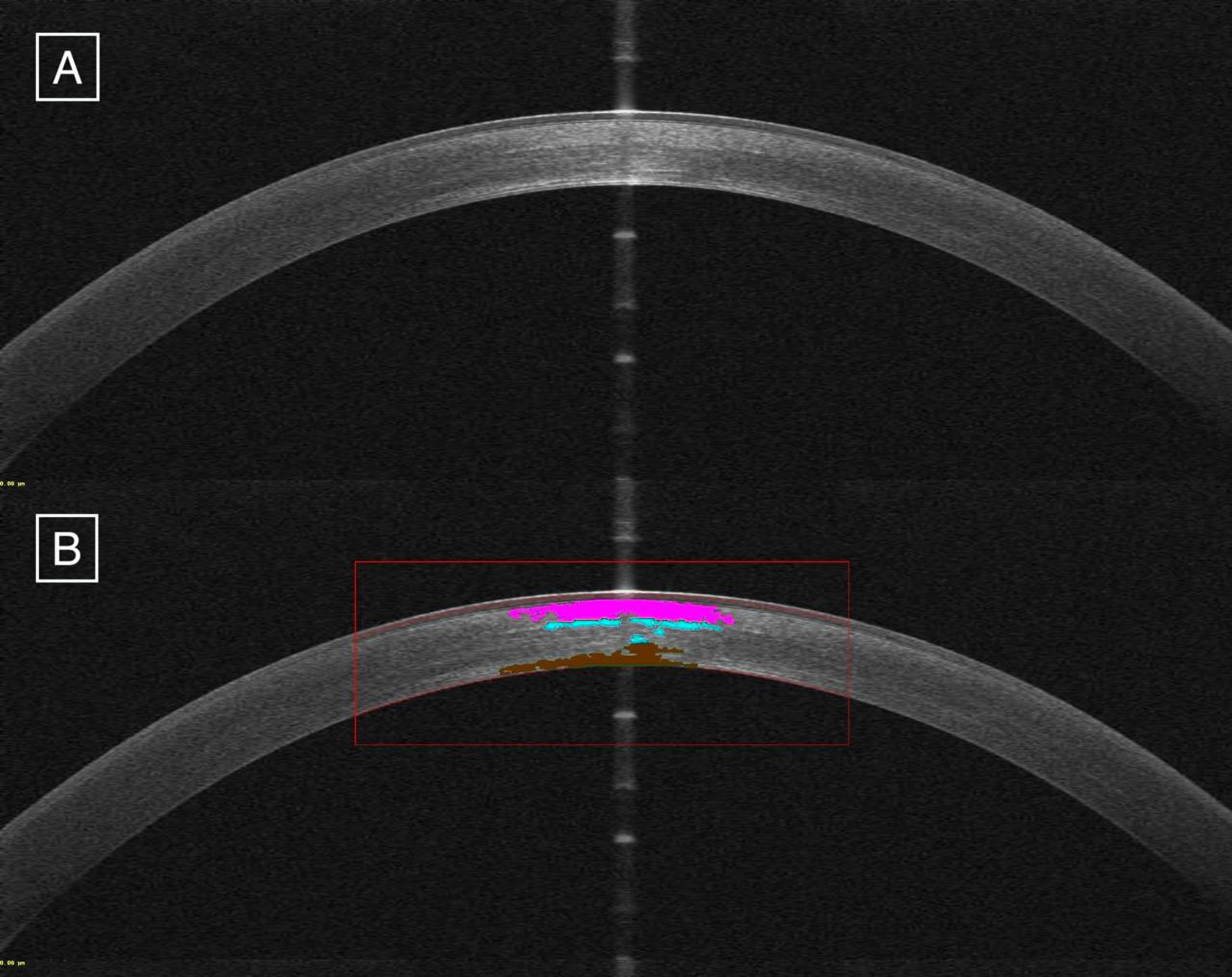
Eyes included in the study were identified from a consecutive series of 118 eyes that had been prospectively followed at 1, 3, 6, and 12 months after simultaneous trans-PRK/A-CXL (n = 90) or following trans-PRK performed after A-CXL (median 36 months, n = 28). Dr Awwad was the one surgeon and used the same laser platform for all trans-PRK procedures. Mitomycin C was used only in cases of sequential trans-PRK.
Propensity score matching was conducted using age, sex, corneal thickness, Kmax, Kmean, and total coma and yielded two cohorts of 27 eyes each for the outcomes analyses. Baseline characteristics were similar in the two groups. At 12 months, both groups achieved a mean corrected distance visual acuity gain of two lines along with statistically significant improvements in Kmax and total corneal coma, and there were no statistically significant differences between groups in any of the three outcomes.
The OCT haze assessments showed reflectivity increased initially and then decreased with layer- and time-dependent kinetics. Some differences between groups were noted through follow-up to 6 months, but reflectivity profiles converged at 12 months, indicating no clinically meaningful difference in late haze burden, Dr Awwad said.
Offering his personal preference, Dr Awwad said he would probably favour performing the customised trans-PRK and A-CXL simultaneously in eyes with a moderate degree of optical aberrations. In more mildly aberrated eyes, however, the sequential approach may be preferable, performing cross-linking first and reserving customised trans-PRK for later if it is still needed. Dr Awwad also emphasised that the customised treatment strategy he uses primarily targets higher-order aberrations rather than lower-order refractive error.
“We do not intentionally treat the lower-order aberrations except for the component that is intrinsically embedded within the higher-order aberration correction. We published our approach to this concept in the August 2026 issue of The Journal of Refractive Surgery,” he said.
The algorithm for objective haze quantification developed by Dr Awwad and colleagues is also published in articles appearing in the American Journal of Ophthalmology, Cornea, and The Journal of Refractive Surgery.
Shady Awwad MD is Professor of Ophthalmology and Head of Cornea and Refractive Surgery, American University of Beirut Medical Center, Beirut, Lebanon.