Meetings, Cataract, Patient Journey, Refractive, Refractive Surgery
Predicting Possible Cataract Outcomes
Can preoperative aberrometry and straylight measurement help?


Sean Henahan
Published: Monday, October 19, 2026
“ Cataract degrades optical quality through two independent mechanisms that have never been combined to predict outcomes—aberrations and straylight. “
The current indication for cataract surgery relies on patient-reported complaints, visual acuity, and slit lamp assessment. However, preoperative visual acuity has been shown to be a poor predictor of surgical outcome, and no tool reliably predicts which patients will experience meaningful functional improvement with surgery.
The primary indication for cataract surgery is a loss of visual function that interferes with daily activities due to lens opacities. If surgery is not expected to improve visual function, it should not be performed, notes Nic J Reus MD.
Cataract surgery has a high overall success rate, with 90% of patients reporting an improvement in their visual function. But what about the other 10%? With more than five million cataract surgeries performed in the EU each year, this means 500,000 patients do not report an improvement in visual function after surgery. 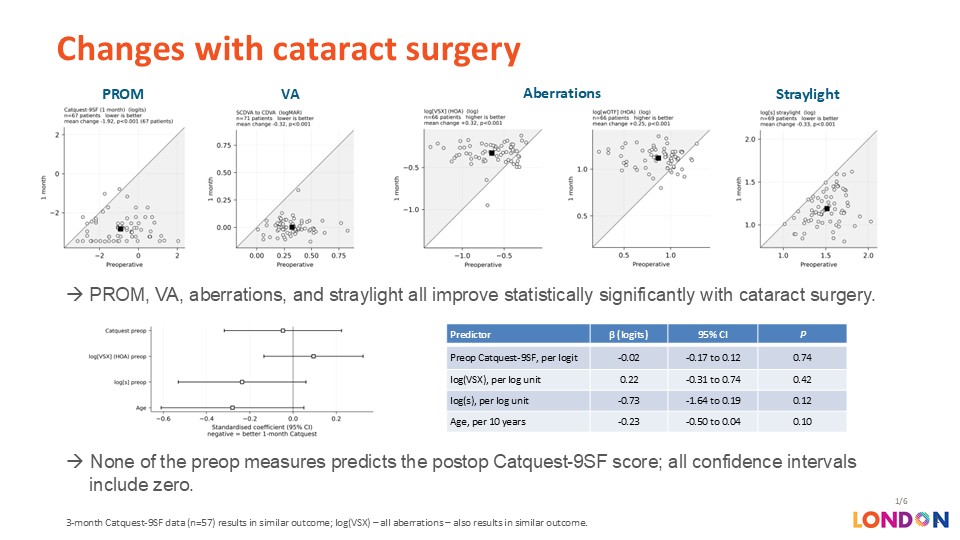
“This is more than the population of Iceland,” he said. “Even this modest dissatisfaction rate produces the largest affected group of any elective procedure in Europe.”
Cataract degrades optical quality through two independent mechanisms that have never been combined to predict outcomes—aberrations and straylight. Dr Reus and his colleagues in the ophthalmology department at the Amphia Hospital in Breda, Netherlands, conducted a study to determine whether objective optical quality metrics—such as aberrometry and straylight measurement—could provide a more direct measure of lens-induced optical degradation, independent of subjective reporting.
The study evaluated 53 patients who underwent preoperative and one-month postoperative aberrometry (iTrace, Tracey Technologies) and straylight measurement (C-Quant, Oculus) in both eyes. Aberrometry was expressed as the log of the visual Strehl ratio, an optical metric that incorporates an age-related neural contrast sensitivity function at 900 trolands. Straylight was expressed as logs.
The researchers also assessed visual function with the Catquest-9SF questionnaire before and after surgery. They measured uncorrected (UDVA), corrected (CDVA), and spectacle-corrected distance visual acuity (SCDVA).
A linear mixed-effects model (random intercept for patient) assessed whether preoperative log[VSX], log[s], baseline Catquest-9SF score, and age predicted the postoperative Catquest-9SF Rasch score.
Cataract surgery significantly improved mean visual acuity. SCDVA improved from 0.32±0.18 preoperatively to 0.29±0.18. UDVA and CDVA improved by similar degrees. Aberrations also showed statistically significant improvement in all measures (P < 0.0001).
Patient-reported visual function also improved significantly. Mean Catquest-9SF Rasch score changed from -1.10±1.25 to -2.86±0.70 (P < 0.0001). In a linear mixed model adjusted for preoperative Catquest-9SF, log[VSX], log[s], and age, only age independently predicted postoperative patient-reported outcomes.
None of the preoperative measures predicted the postoperative Catquest-9SF scores. Catquest scores clustered at the questionnaire ceiling, leaving little variance to predict outcomes, Dr Reus noted.
“These findings indicate that the relationship between measured optical degradation and postoperative patient-reported visual function is not straightforward,” Dr Reus concluded. “Further research is needed to better understand how objective optical metrics relate to patient-reported outcomes.”