Retina
MCO-010 Optogenetic Therapy for Vision Restoration
Long-term study documents durable safety and efficacy profiles in advanced retinitis pigmentosa.


Cheryl Guttman Krader
Published: Wednesday, January 7, 2026
“ Only a single patient treated with MCO-010 developed vitritis requiring ongoing management with a topical corticosteroid. “
A single intravitreal injection of MCO-010 optogenetic therapy continues to demonstrate safety and is providing durable, clinically meaningful vision improvement in patients suffering severe and permanent vision loss from advanced retinitis pigmentosa (RP), new clinical results suggest.
“MCO-010 is currently undergoing the Biologics License Application process at the US Food and Drug Administration and hopefully will be approved soon,” said Jordi Monés MD, PhD.
Nanoscope Therapeutics is developing MCO-010, a transgene for a high-performing opsin that sensitises bipolar cells to light stimuli. It is delivered by a proprietary adeno-associated virus and uses the mGluR6 promoter-enhancer to ensure the opsin gene is expressed specifically in retinal bipolar cells.
“MCO-010 solves crucial issues that limited the success of other optogenetic therapies for retinal degenerative diseases,” Dr Monés explained.
“Thanks to the mGluR6 promoter, it transduces bipolar cells that are ten times more numerous than ganglion cells and lead to higher resolution. In addition, MCO-010 is sensitive to all wavelengths of visible light, responds to ambient light levels, and has rapid kinetics for no image blur.”
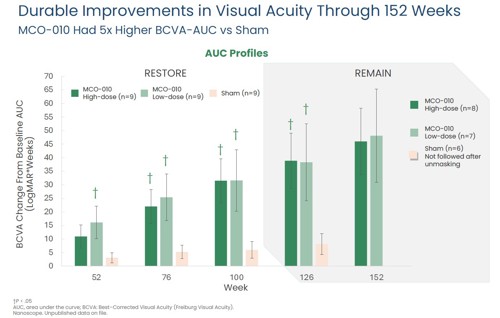
BCVA-AUC demonstrates durable improvements in visual acuity through 152 weeks after MCO-010 dosing. Comparison of BCVA-AUC profiles demonstrates 5-times greater vision gains in both MCO-010 dose groups and statistically significant improvements compared to sham control.
The 152-week results were collected from patients participating in REMAIN, a long-term follow-up study of RESTORE, a phase 2b/3, multicentre, double-masked study that randomised 27 patients 1:1:1 to receive low-dose MCO-010 (0.9E11 gc/eye), high-dose MCO-010 (1.2E11 gc/eye), or sham injection. Patients enrolled in RESTORE had a clinical diagnosis of advanced RP with BCVA in the study eye worse than 1.9 logMAR (Snellen equivalent 20/1600) and no better than 1.6 logMAR (20/800) in the fellow eye.
RESTORE met its primary endpoint, showing that at week 52, patients treated with both the low and high doses of MCO-010 achieved significantly greater BCVA improvement from baseline compared to the sham group. At week 52, the mean change from baseline in both MCO-010 groups corresponded to about 3 ETDRS lines, and 40% of patients gained at least 3 ETDRS lines. The study also met key secondary endpoints, analysing the change in BCVA from baseline to week 76, with additional improvements observed in shape discrimination and mobility testing, and with tolerable ocular and systemic safety.
Eight patients treated with the high dose of MCO-010 and seven patients treated with the low dose were evaluated at week 152 in REMAIN, and their BCVA results showed the optogenetic therapy’s benefit for improving visual function remained stable. Mean improvement in BCVA from baseline to week 152 was 0.243 logMAR in the high dose group and 0.454 logMAR in the low dose group; 40% of patients still maintained a gain of 3 ETDRS lines.
Its safety is consistent, and there have been no serious adverse events nor cases of retinitis, choroiditis, vasculitis, ischemic neuropathy, hypopyon, or hypotony. Presence of anterior chamber cells was the most frequent adverse event in the MCO-010 groups (low dose 66.7%, high dose 33.3%, sham 22.2%), followed by ocular hypertension (low dose 44.4%, high dose 44.4%, sham 11.1%). These adverse events were mild or moderate in severity and controlled with short-term topical therapy. Only a single patient treated with MCO-010 developed vitritis requiring ongoing management with a topical corticosteroid.
Dr Monés spoke at the 25th EURETINA Congress in Paris.
Jordi Monés MD, PhD is Director of the Institute de la Macula, Barcelona, Spain. jmones@institutmacula.com