Cataract, Refractive Surgery, Refractive
Late Post-LASIK Enhancements
Epithelial thickness mapping provides valuable insight for treatment and patient counselling.


Cheryl Guttman Krader
Published: Wednesday, January 7, 2026
“ After hyperopic LASIK, almost any eye with refractive error is going to have a very irregular and somewhat unpredictable epithelial layer. “
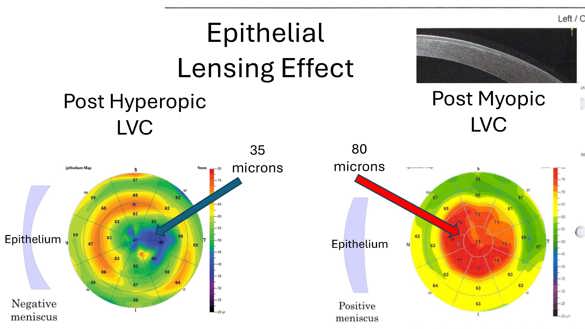
Epithelial remodelling after LASIK can lead to refractive changes due to the lensing effect of the epithelial layer, but the pattern of remodelling is highly unpredictable. Therefore, epithelial thickness mapping can help guide the best treatment option for patients who present with significant refractive error years after LASIK.
Photorefractive keratotomy (PRK) is performed most often for refractive correction, but surgeons must also set proper patient expectations during preoperative counselling—knowing the rate and pattern of epithelial regrowth after PRK is variable.
These were the take-home messages provided by Julie M Schallhorn MD and Steven J Dell MD, who discussed the role of epithelial mapping in guiding treatment when a patient presents with 3.0 D of myopia ten years after myopic LASIK.
Emphasising the variability of epithelial remodelling after refractive surgery and its role in the surgical outcome, Dr Schallhorn discussed a study that analysed the impact of corneal epithelial thickness on refractive error in eyes that had LASIK for myopia or myopic astigmatism.1 The study included more than 200 eyes, and the researchers concluded that the difference in corneal epithelial thickness between the central and midperipheral zones may play a role in the final refractive error. Notably, the individual patient data showed huge variability in the magnitude of the difference between the central and midperipheral zones.
Further underscoring the point that “epithelial remodelling is not created equally” and should be considered when planning a late enhancement, Dr Schallhorn presented two cases from her personal files. One case involved a 56-year-old female, seen ten years after myopic LASIK, whose corneal epithelium was thin centrally and thicker inferiorly. The second case involved a 58-year-old male who was eight years post-myopic LASIK and had a very thick central epithelium.
“If you treat these patients with PRK based only on their residual refractive error, you will get a different outcome based on their post-treatment epithelial thickening,” she said.
Considerations for performing PRK
Drs Schallhorn and Dell agreed PRK would be the best option for late refractive correction in a post-LASIK patient.
“We don’t want to relift old LASIK flaps because of the risk of epithelial ingrowth,” Dr Dell said. “We could make a new side cut, but that is technically difficult and not commonly done. Another approach would be to cut a larger, deeper flap encompassing the entire prior flap, but that is also not commonly done. In rare cases, an ICL may be an option.”
Although PRK may be the best option for a late enhancement procedure in a post-LASIK eye, both surgeons emphasised that it is not perfect.
“Late LVC enhancements are complicated,” Dr Dell said. “The epithelium hides a lot of LVC sins, but it also creates new issues for us.”
Dr Schallhorn explained that the epithelium does regrow after PRK when it is performed over a LASIK flap, but the process is slow, and in a sizeable proportion of cases the epithelium does not always return to its pre-PRK configuration. Therefore, the outcome of PRK can be unpredictable.
“Regrowth of the epithelium is a finicky business. It depends on the magnitude of the preoperative treatment, but it is also impacted by other factors, such as postoperative topical drop use,” Dr Schallhorn said. “These patients have come for treatment of refractive error and might have become presbyopic. If they are being treated with PRK to treat myopia, they will probably be hyperopic until the epithelium regrows. However, post-PRK epithelial hyperplasia can be massive in some patients and very minimal in others, and it will take a long time to re-establish the same epithelial thickness that was present before the procedure. That is why we tell patients it will take a lot longer for visual recovery after the retreatment compared to initial procedure.”
Illustrating the variability in regrowth after a PRK enhancement, Dr Dell presented a patient he treated for -3.0 D myopia bilaterally. Both eyes had a central epithelial thickness of about 75 microns. At four months after PRK, the epithelium had reverted to its preoperative pattern in the left eye, and the refractive outcome was perfect. The right eye, however, was hyperopic because the epithelium was thin and irregular.
“This begs the question, what is the refractive surgeon to do?” Dr Dell said. “Do you wait and see if the epithelium eventually reverts to its original configuration? Or do you try to split the difference of the epithelial lensing effect in your preoperative planning?”
He noted that the epithelial lensing effect is generally proportional to the magnitude of the original LVC correction.
“If the primary correction was for -3.0 D of myopia, it will probably not be a problem, but it will be if the original correction was for more than -6.0 D. I find that after hyperopic LASIK, almost any eye with refractive error is going to have a very irregular and somewhat unpredictable epithelial layer,” Dr Dell said.
Drs Dell and Schallhorn spoke on this topic at AAO 2025 in Orlando, Florida, US.
Steven J Dell MD is Medical Director at Dell Laser Consultants, Austin, Texas, US. steven@dellmd.com
Julie M Schallhorn MD, MS is Professor and Rose B Williams Chair for Research in Corneal Disease, Department of Ophthalmology, University of California–San Francisco School of Medicine, San Francisco, California, US. julie.schallhorn@ucsf.edu
1. Cho Y, et al. Am J Ophthalmol, 2019; 207: 326–332.